Calculating Daily Pack Weights and Caloric Demands
Every ounce hauled across alpine talus demands measurable metabolic output. When pack weights escalate beyond physiological efficiency, physical fatigue compromises balance, leading directly to slips, ankle inversions, and compromised mental focus.
The Caloric Density Equation
On technical cross-country routes, an active hiker burns between 3,400 and 4,800 calories per 24-hour cycle. To carry seven days of sustenance without exceeding pack capacity, provisions must deliver a minimum density of 125 to 140 calories per ounce (4.4 to 4.9 kcal/gram).
✦ MACRONUTRIENT RATIO FOR SUSTAINED EFFORT
Prioritize lipid-dense rations. Fat yields 9 calories per gram, compared to only 4 calories per gram for pure carbohydrates or proteins. Incorporating nut butters, macadamia nuts, olive oil drizzle pouches, and dehydrated whole-milk powders maximizes caloric yield per carried pound.
Base Weight vs. Total Pack Weight
In modern backcountry terminology, Base Weight comprises all equipment carried minus consumables (food, water, stove fuel). Achieving an 11 to 14 lb base weight provides structural safety margins while keeping total pack weight well under the threshold where joint degradation occurs.
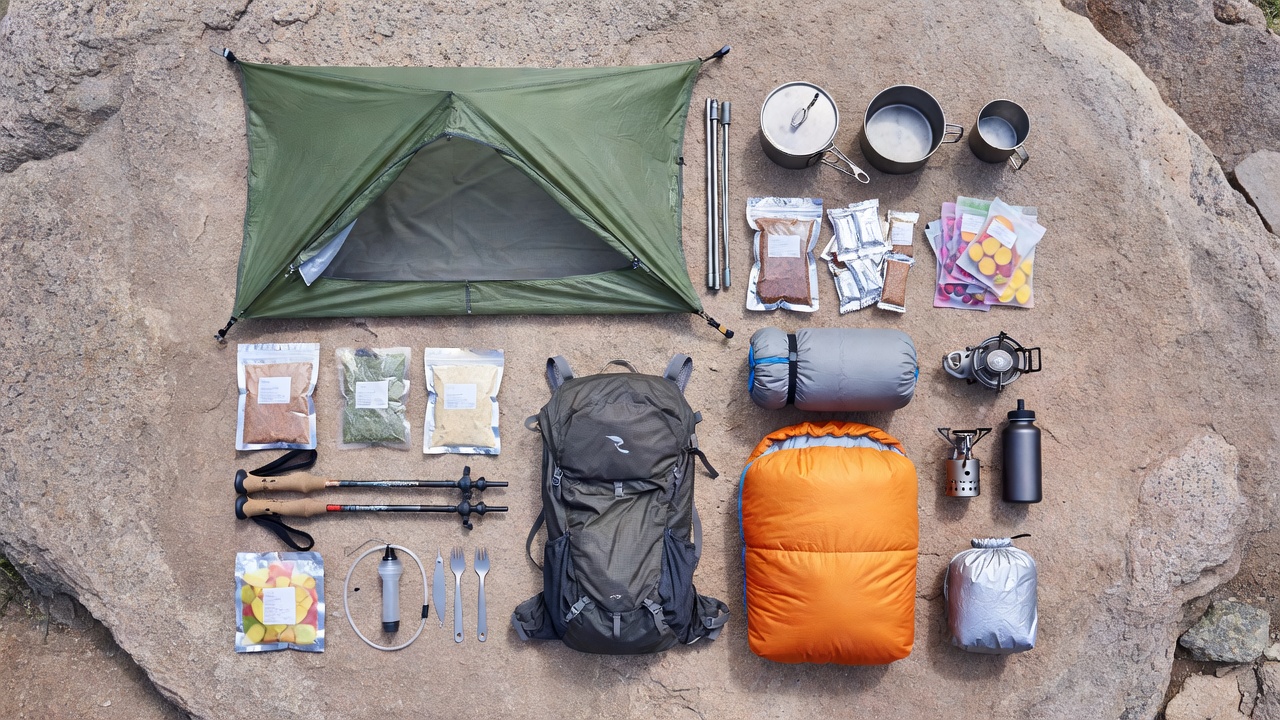
1. Shelter System: Non-freestanding trekking-pole pyramid tarp or single-wall silpoly shelter (22-28 oz). Eliminates dedicated tent poles by utilizing dual carbon-fiber trekking poles.
2. Sleep System: 850+ fill-power down quilt rated to 20°F coupled with an ASTM R-value 4.5+ insulated inflatable sleeping pad (32 oz total).
3. Pack Architecture: 45-55L frameless or lightweight aluminum stay pack constructed from ultra-high-molecular-weight polyethylene (UHMWPE) laminate (28-36 oz).
Never trim critical emergency gear: a physical liquid-filled sighting compass, true 1:24,000 scale paper topographic quadrangles in a waterproof sleeve, a backup chemical water purification vial, and a dedicated personal locator beacon (PLB) with satellite SOS triggering capabilities.